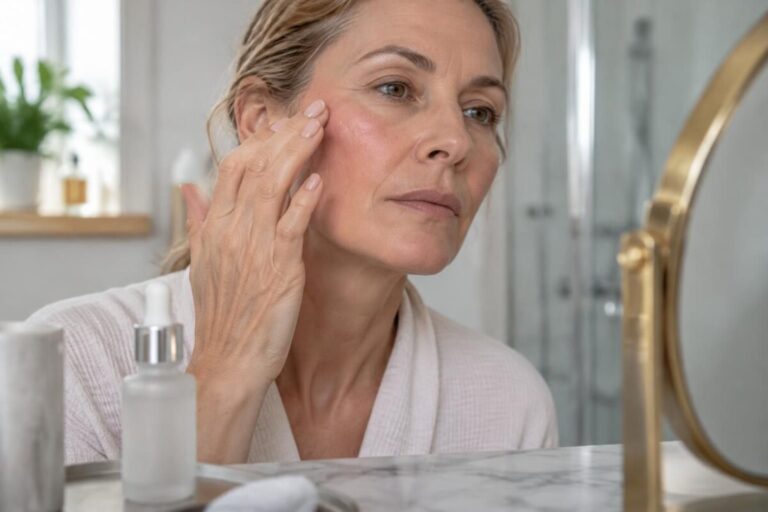
Beauty routines: too many steps can inflame your face
Hi, it’s Aurore. Too many steps can irritate your face: keep your routine simple with a gentle cleanser, a moisturizer, and sun protection in the morning. When products pile up, active ingredients can overlap and weaken the skin barrier. Redness, tightness, or tingling are signs that it’s time to take a break. My advice: observe your skin and add products one at a time.
What to do right away
- Reduce your beauty routine to just a few products that are truly useful.
- Cleanse your face with a gentle product, without rubbing.
- Choose a moisturizer suited to your skin, with soothing ingredients such as ceramides or panthenol.
- Avoid using retinol and an exfoliant on the same evening.
- Temporarily stop using any new product if skin irritation appears.
Why using too many skincare products can inflame your face
Each product contains ingredients, and sometimes fragrance or preservatives too. Layering several products can increase the risk of a reaction, especially if your skin sensitivity is already high or you change your routine frequently.
Exfoliating ingredients and retinol should be introduced gradually. If used too often, they can contribute to over-exfoliation and make your skin more reactive. Vitamin C and niacinamide are not automatically incompatible: if your skin tolerates them, they can be used together. If you experience tingling, it’s best to simplify your routine and test them separately.
A reader who had just added several serums noticed redness and tightness a few days later. By setting the new products aside and returning to a short routine, she was able to identify more easily what didn’t suit her.
“Less is more, as long as you choose wisely”: this rule helps prevent your routine from becoming a source of stress for your skin.
Redness and skin irritation: signs to watch for
Persistent tingling, burning sensations, tightness, or new redness may signal that your skin does not tolerate a product or combination well. However, facial inflammation is not always related to cosmetics: if symptoms persist, get worse, or are painful, seek advice from a healthcare professional.
If you have sensitive skin and develop redness after using a new product, stop using it and return to a gentle routine. If you mainly have oily skin with blemishes, avoid washing and exfoliating too often: these can also weaken your skin.
To better distinguish a temporary reaction from a sign that needs attention, read this guide on temporary or persistent redness. If the irritation seems related to your routine, this article can also help you understand how to tell diffuse redness from irritation.
A minimalist three-step routine
A minimalist routine doesn’t mean neglecting your skin. Instead, it helps limit layering and makes it easier to figure out which products suit you.
- Step 1 — Cleanse: use a gentle cleanser, especially in the evening to remove the day’s residue. In the morning, rinsing with water may be enough if your skin is dry or reactive.
- Step 2 — Moisturize: apply a cream or lightweight product suited to your needs. Avoid adding several serums until you know how your skin reacts.
- Step 3 — Protect: in the morning, apply suitable sun protection when your skin is exposed to daylight.
If you want to use an active ingredient such as retinol, start by applying it occasionally, for example once or twice a week depending on your tolerance. Don’t add an exfoliant at the same time: changing just one thing at a time makes reactions easier to understand.
Identifying products to use at different times
There is no combination that is universally off-limits for everyone. The safest approach is to adjust how often you use products based on your tolerance and avoid combining several powerful active ingredients at first.
| Product or combination | Simple advice |
|---|---|
| Retinol and exfoliating acids | Use them at different times, or even on different evenings, especially if your skin reacts easily. |
| Several serums with active ingredients | Start with just one serum so you can better assess its effects. |
| Harsh cleanser and frequent scrubbing | Reduce friction and choose gentle cleansing. |
| Vitamin C and niacinamide | This combination does not always need to be avoided; focus on how well your skin tolerates it. |
If redness tends to return when you wake up, also check your evening habits and the products left on your skin: this routine mistake can keep morning redness going.
Taking a break without giving up essential skincare
If you feel discomfort, set aside recently added products and keep only the skincare products you tolerate well. A break mainly means pausing irritating active ingredients: don’t automatically stop using sun protection if your skin is exposed to daylight.
“Skin fasting,” or taking a break from cosmetics, is neither mandatory nor a one-size-fits-all solution. Some sensitive skin benefits from a simplified routine, while other skin needs its usual moisturizer to stay comfortable.
To keep track, write down the products you use and any reactions you notice over a few days. This simple method helps you identify changes without trying lots of different things.
Common questions about overly complicated beauty routines
How can I tell if I’m overloading my skin with skincare products?
Tightness, tingling, redness, or a burning sensation after adding products may indicate irritation. Stop using the suspected product and seek advice if symptoms persist or get worse.
Can I use several serums in the same routine?
Sometimes, but it’s best to start with just one serum. You can assess how well your skin tolerates it before adding another, without introducing several active ingredients at once.
What should I do if a skincare product causes skin irritation?
Stop using it and temporarily simplify your routine with gentle products you already know. If the reaction is significant or persistent, consult a healthcare professional.
How often should I start using retinol?
Start by applying it occasionally, for example once or twice a week depending on your tolerance. Avoid using it on the same evening as an exfoliant, especially at first.
Thanks for reading; Aurore. I’d be grateful if you left a comment at the bottom of the article. THANK YOU!